The full report
Recipes beat showcases
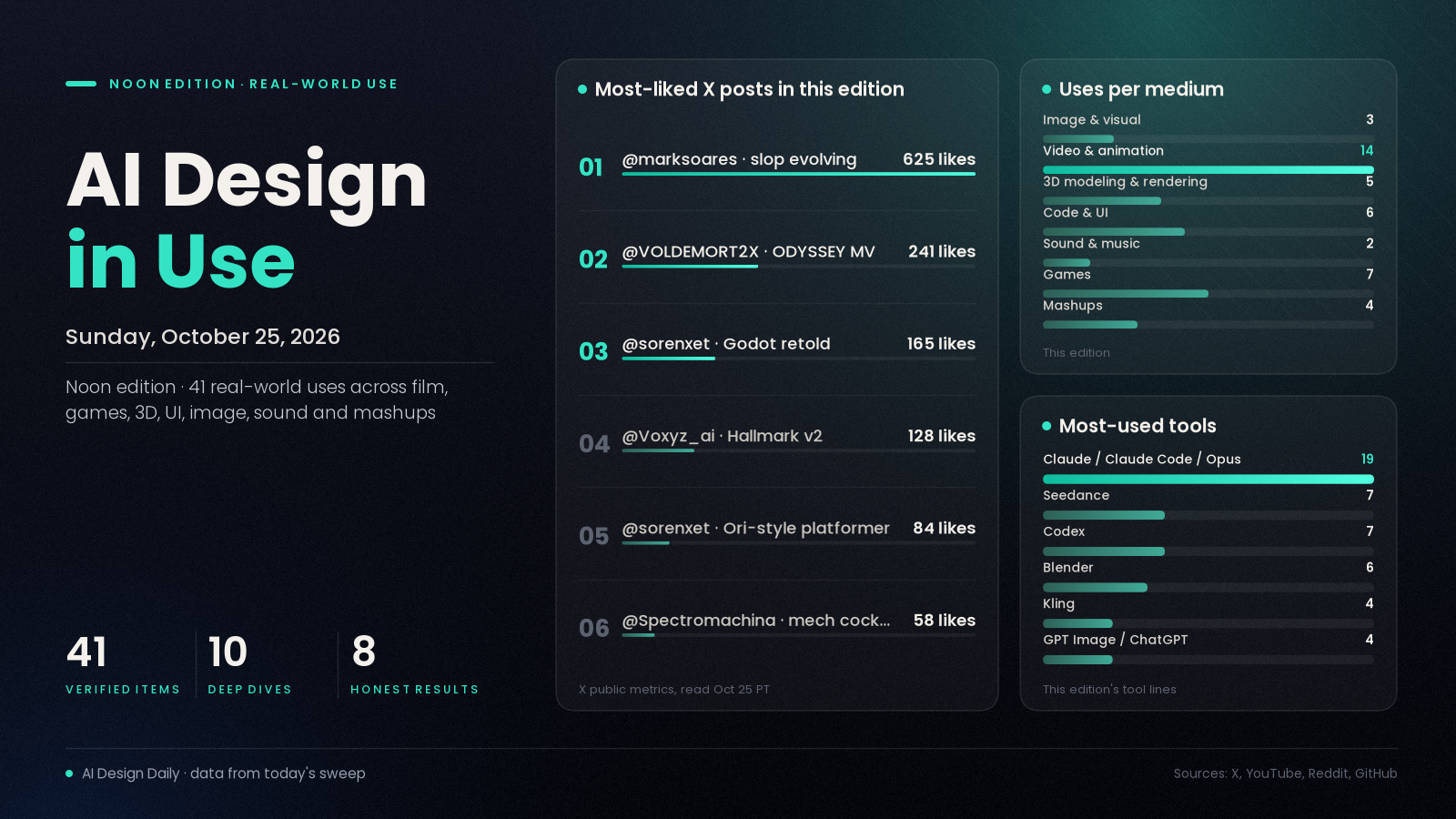
The most useful posts today read like recipes. The Ori-style platformer thread lists eight steps and who does what: GPT Image 2.5 for every mood board, Tripo and Blender for every model, Opus 5.5 for the code, camera and weather, and ElevenLabs for sound at the very end. Its rule is to ship the ugly version that works before polishing anything.
The six-week Godot game from Saturday is now being retold line by line in several posts. Its core move is the same: one feature at a time, tested in the game before the next exists, with every working image prompt saved as JSON so the art style does not drift.
Hallmark, the design skill for coding agents, shipped a second version and now audits an existing page or redesigns it while keeping its content, links and forms. A smaller tool, tastelint, takes the opposite approach and fails a build when an interface scores under 90 on its taste checks.
Agents debugging things they cannot see
ScreenPlink is the most instructive build of the day. A webcam watches a monitor to find where a laser hit, and Claude Code wrote essentially all of the code over about two weeks. The author says the hard part was never the game logic but getting an agent to debug a program that measures the physical world. The fix was an MCP server inside the app that returns measurements, including what the detector rejected and why, and never the app's own conclusions, because those were repeatedly wrong.
A similar discipline shows up in the Flight Simulator 95 and 98 fix, where Claude Code first patched two DLLs, then found the real fault in the executable and added an 86-byte exception handler. A jipvandervelde thread on the Zen Garden app reports a model choosing shaders over 3D models and adding life-size birds nobody asked for, which he credits to asking it to go harder on small details.
Video: tool lists and prices
Video posts increasingly name every tool. One slopcore music video lists Midjourney for images, Claude Opus 5.5 as director, Grok Imagine, Kling and Veo 3.1 for motion and OmniHuman 1.5 for lip sync. Another maker reports a music video in about 16 hours for $33.34 with Codex, Runway and Seedance. Those costs are their own figures and the posts had little reach, so they are claims, not benchmarks.
A format post to watch is founder ads as toddlers, built from a real ad with Nano Banana Pro and Wan 3.0. Several contest entries for the 'world's catchiest ad' also appeared, with jingles from ElevenLabs and clips from Seedance 2.5 and Kling 4. Those are promotional by design.
3D, image and sound
In 3D, agents wrote scenes as scripts or drove Blender: a 784-frame launch film in Blender 5.2 with no Blender MCP, a procedural water scene made with Codex and Cycles, a mech cockpit from two prompts and a harness, and a Gothic cathedral from one image in Antigravity. Several of those posts had almost no reach and some end in sales calls, which the notes flag.
On r/StableDiffusion, one user tested twelve different people in a single MOSS-Image photo from a 1.3K-token prompt, another shared a Krea 2 style LoRA for an early 20th-century fashion illustrator, and MiniMax H3 got a first test on an RTX 3090. Sound was thin: a cyberpunk music video made with Suno, and a user report that Grok Imagine has a Music Panel, which we could not confirm with xAI.
What to watch next
Two things to watch: whether more builders publish the harness that let an agent test its own work, and whether the contest-style ad entries show up with measurable results. Tell us which topics to chase next: a medium, a tool, or one of these stories, and the next edition will steer there.




 Great Creation Studios