The full report
Agents inside the tools
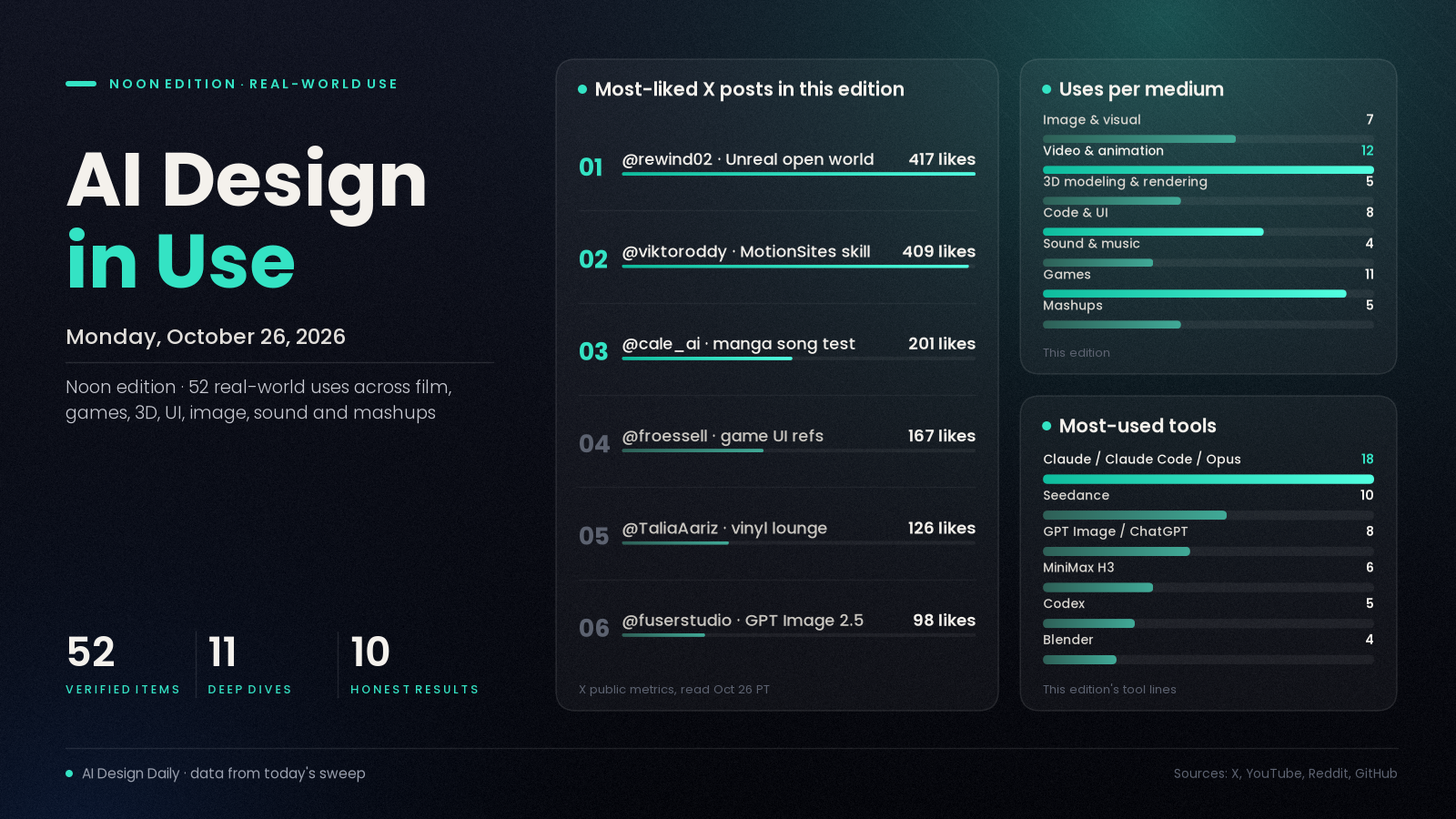
The most useful posts today put the model inside the software rather than next to it. The Unreal prototype connects Opus 5.5 to the engine through MCP and lets it build the map, combat and effects, while a person makes the hero in Tripo and cleans it in Blender. A developer building an MMO with parallel agents adds context: Unity and Unreal 5.8 now ship official MCP servers, Godot and Bevy are agent-friendly because scenes are text or code, and engine projects disagree sharply on whether they accept AI-written pull requests.
The Flock wolf thread is the clearest lesson in checking work. Claude's first rig stretched the jaw and grew spikes on the chest. Instead of more prompting, the maker gave it a 5-second Seedance walk cycle of the same wolf and had it compare frames. In Houdini, another artist used Claude for retopology and UVs on an AI-generated model, the slow middle steps that rarely get credit.
Design skills for coding agents
Taste is being packaged as skills. A designer turned more than 700 of their own site designs into a free MotionSites skill, the most-bookmarked post in this edition, and others showed Claude Code building themed forms with Open Form, polishing a developer's rough app, and a CRM built with a taste skill. These are the makers' own results; the MotionSites repo was a day old when we checked it.
Game builders are doing the same with references: a list of six game-UI libraries, including a free archive of over 78,000 screens, drew more bookmarks than likes. Riposte, a browser FPS built entirely with Claude Code and no external 3D assets, went open source under MIT.
Video: recipes and honest limits
Video posts keep naming their stacks. A POV short lists GPT Image 2.5 in Codex for key frames, Grok Imagine 1.5 for first-and-last-frame motion, Topaz for upscale, Suno V6 for music and Claude Code with ffmpeg for the edit. A 23-shot sci-fi reel splits work between Seedance 2.5 and MiniMax H3. One creator ranked four models on acting anger and sadness and put Seedance 2.5 first, a test that links to their own platform.
Local MiniMax H3 work is growing up. The '80s commercial ran on one 5090, another clip lists its exact Int8 settings, and one user reports a real limit: characters keep moving their mouths even when told not to speak.
Image, sound and pipelines
On r/StableDiffusion, people shared training results rather than pretty pictures: a Krea 2 LoKR test with 3, 8 and 15 images (good likeness at 1,000, 1,440 and 2,100 steps), MOSS character LoRAs finally working after days of failures, and a splat-repair LoRA retrained for Qwen-Image 2.1. A free ComfyUI node pack brings Grasshopper-style data trees so batches keep their structure.
Sound was mostly about people layering human work on AI: a sound designer re-scoring another creator's AI short, a Suno post-production tutorial, and a parent whose Claude Code build turned one MP3 into a drum game for a real e-kit. One manga creator noted their project is paused because the credits ran out.
What to watch next
Two things to watch: whether more builders share the reference or test harness that let an agent check its own output, and whether engine projects settle their rules on AI-written code. Tell us which topics to chase next: a medium, a tool, or one of these stories, and the next edition will steer there.








 Great Creation Studios