The full report
A music video that shows its books
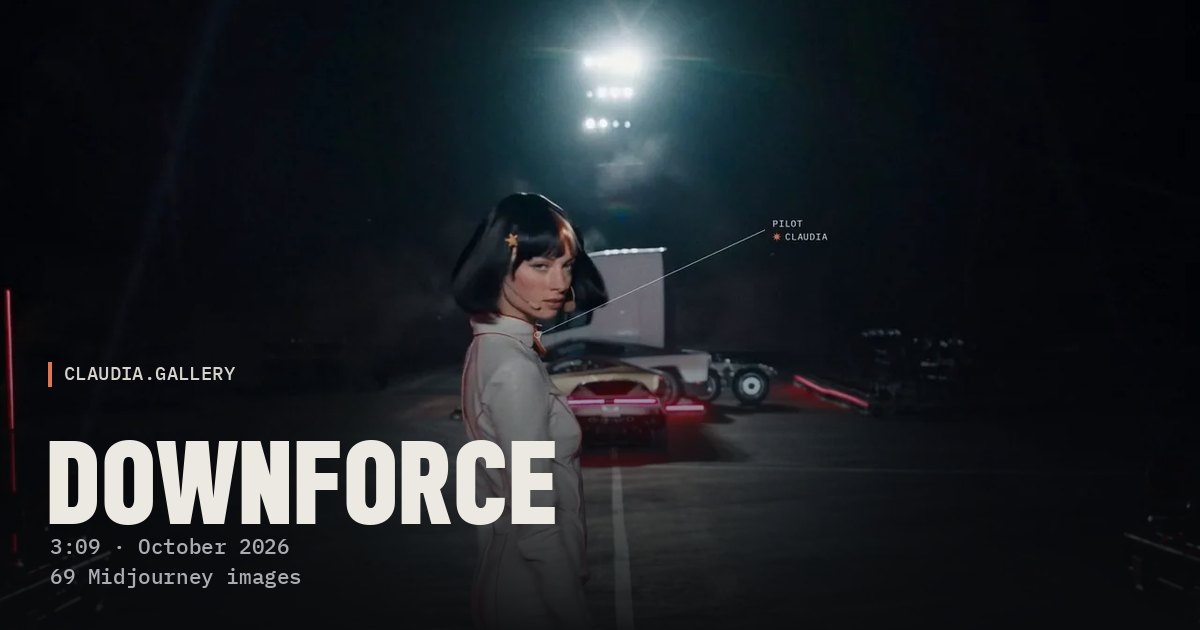
The most complete production record of the day comes from claudia.gallery, home of an open AI character named Claudia. She is the singer in seven music videos made with Claude in September and October 2026. DOWNFORCE runs 3:09.6. It cuts real footage of Tesla's Oct 15 Roadster demo, mostly from the livestream, together with generated shots to a Memphis-phonk Suno song. The "How it was made" page gives about 13 hours of wall-clock time and 172 agent launches with Claude Code (Opus 5.5) as production lead. It also lists 80 Midjourney v8.2 plates, 63 Wan 3.0 submissions through the Higgsfield API ($66.98) and 16 Seedance 2.5 submissions ($76.20). The total was $143.17 of a $200 budget, for 4,550 frames at 1080p24.
The useful part is the "What didn't" list. Wan lost the car when it turned to sides it hadn't seen, and Seedance sometimes cut away to its reference images. Most showcase posts leave this out. The same instinct shows up in a new agent skill on GitHub that turns one sentence into a hand-drawn-looking 2D short. It runs a story interview, character sheets, a storyboard and one master prompt, then makes a single Seedance generation in CapCut and finishes with QA and a pencil animatic. It's dedicated to Tyrus Wong, whose painted forests defined Bambi.
One layer, one feature, one system at a time
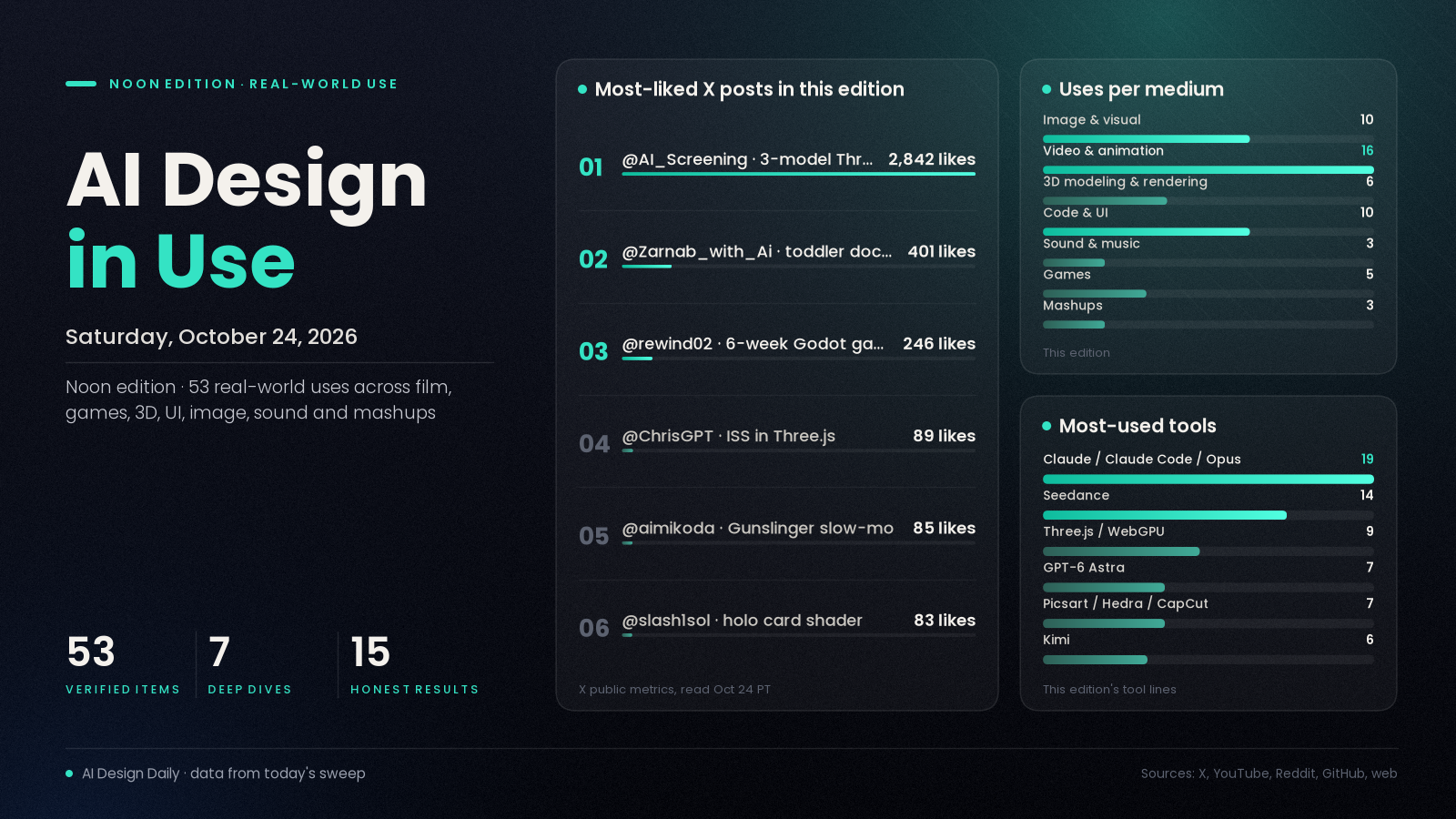
The best small technique of the day is @slash1sol's holographic Pokémon card. He photographed a card from his own binder and turned it into a real shader with diffraction grating, eight foil patterns and drag-to-tilt, in 38 minutes for $2.10 with Kimi K3.1 Pro and Three.js. His rule: never ask for "a holo card shader". Ask for one layer at a time.
The same discipline runs through the games posts. @rewind02, who says he has no coding background, built a game in six weeks with Opus 5.5 and Godot by doing one feature at a time: build it, test it in the game, adjust, then move on. Hours later he posted an Unreal Engine 5 clock tower whose 'echo shift' mechanic was built as a system first and greyboxed second. A Godot developer built a whole main menu from primitives and shaders "one step at a time", and another creator is reviving a puzzle game from his 2020 design journal with Astra and Opus.
The meter is now part of the post
Three.js head-to-heads dominated the code posts, and almost all of them list time and cost. The most-liked post in this edition, with about 2,800 likes, pits Kimi K3.1 Pro, Opus 5.5 and GPT-6 Astra against each other on one single-file scene. The more useful ones add numbers. On a soft-body gummy eyeball, Astra took 4 minutes and $1.07, Kimi 8 minutes and $0.24, and Opus 19 minutes and about $6.09. Opus was the only one that delivered the whole brief. A vacuum-decay simulation cost $17.48 over 1h 20m on Opus and $9.00 over 33 minutes on Astra. A whale animation ran from $0.75 to $3.01 across four models.
The sharpest note came from @kartikktwt's dragon-flight test. A bug in the agent harness meant Kimi never saw its own renders, while Astra checked and fixed its output four times. His conclusion: benchmark the whole agent stack, not just the model. @cesargomz29's single-prompt product motion graphic (26 minutes, $6.74, Sonnet 5.5) and @ChrisGPT's frame-by-frame ISS in Three.js, with custom atmosphere shaders and a 13-bone rig on a Smithsonian spacesuit scan, show how far code-only motion work has come.
Video: cheap, fast and honest about it
Video was the biggest medium today, and the most useful posts were about cost and craft rather than the clips. @laurgrowth made a 60-second faceless explainer cartoon for about $0.99 in an hour: ten Nano Banana images in Google Flow and ten Omni Flash clips at about 10 cents each. @Justin_lords takes apart someone else's 3-minute supplement ad and lays out a cheap rebuild: lock character anchors, generate at 480p, upscale locally in ComfyUI, and end on real product footage. A team testing app-install ads says its Seedance 2.5 cut 'still needs some iteration'. A Street Fighter fan film is openly an early test with unfinished designs.
Model choice is still being worked out shot by shot. A crowded market chase put Kling 4.0 close to Seedance 2.0 but behind 2.5. AI Video School's tests from earlier in the week weighed Kling 4's lower price against Seedance's acting and dialogue. Editing is moving into the terminal too: a Claude Code plugin cuts a talking head from plain-English instructions, and Kling 4.0 now answers the same session through MCP. Several product spots in the feed are Picsart partner posts, labelled as such below.
3D, image and sound
In 3D, agents drove Blender from a single image (a gothic cathedral via Gemini 4 Argon and Blender MCP), an artist open-sourced a browsable model of Bali's Sacred Monkey Forest with 2,275 trees and 120 macaques, and a splat capture called Fatherhood was entered in XGRIDS' World Backup Project. The most ambitious 3D repo turns a coding agent into a city historian. It researches every fact into a sourced FACTS.md, builds the city as a white model and lights it era by era, and its first film, of Xianyang, runs 12 minutes 30 seconds.
Image work on r/StableDiffusion was practical. Someone built an outpainting workflow that paints only the sides of a photo (Qwen 2.1 in ComfyUI, full settings shared). A candid-photo LoRA was trained on an 8 GB laptop GPU, and one user reports roughly 70% likeness from MOSS character LoRAs. In sound, a lyricist turned a Peru trek into a full music video with Suno, and a lyric-video tool timed words to the vocal. One creator argued that realism comes from "prompt+craft+edit" more than from the tools.
What to watch next
Two things to watch: whether more creators publish full production records like DOWNFORCE's, and whether head-to-head tests start reporting the harness as well as the model. Tell us which topics to chase next: a medium, a tool, or one of these stories.







 Great Creation Studios