AI Design in Use · Noon · Tuesday, October 20, 2026 · catch-up edition
An editor's client folder becomes the brief, a $297 lead, and the stills you check before you render
The clearest real-world account in this window comes from documentary editor Chris Cardoza. Claude Code builds his on-brand titles, charts and end cards from a folder of client material, while he still makes the cut in Final Cut Pro. Elsewhere, an agency reports that a lead-gen client's cost per lead fell from $500 to $297 in 30 days after switching to AI animation ads. Motion designers show how to make agents check their own frames, and MOSS-Image dominated the image posts.
This is a catch-up edition, written on Oct 24 for Tuesday, Oct 20. Items were posted between noon Oct 19 and noon Oct 20 PT. Engagement figures (likes, views, points) were read on Oct 24, not on Oct 20, so they include four extra days of traffic.
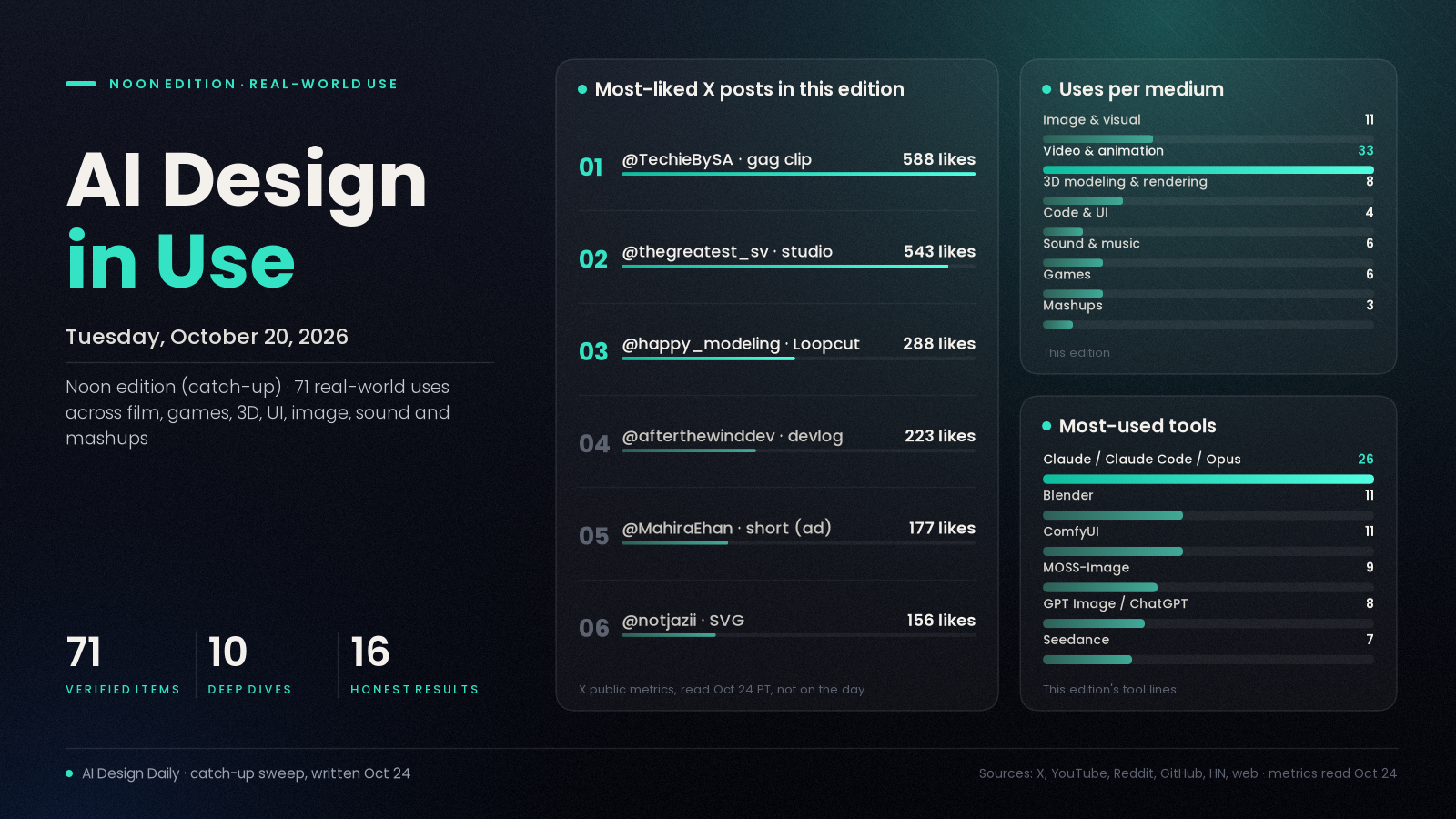
71 verified items · 7 mediums · 16 honest results · sweep window Oct 19–20 PT
The full report
The edit bay, as a working editor describes it
Chris Cardoza's essay on FxFactory's news page, published Oct 20, is the most useful real-world account in this window because it is about client work, not a demo. Every project gets a folder with the brief, goals, fonts, colors, brand guide, shot list, schedule and interviewee names. "The folder is the foundation," he writes. Claude Code with Opus 5.5 reads it, so a request for a lower third already comes back in the client's typeface and blue. He asks for options in bulk (ten lower thirds, six chart animations, three end cards) and picks winners like interview selects. Interviews are transcribed on his Mac before he watches them. An MCP connector lets the agent search the real transcripts with timecodes, so he can ask "what did anyone say about the first winter?" while cutting.
He's open about his stake: he built Doza Assist, the transcription tool in the chain. His conclusion is the part to keep. The editing app "is where the taste lives", and he now spends the hours he used to lose scrubbing footage on structure and story.
Real money, real claims
Two posts put numbers on AI ads for real businesses. An agency owner says a lead-gen client with a $3,500 service was stuck at $500 per lead on standard UGC. AI animation ads made with Higgsfield went into the 20% experimental slot with the same offer, audience and landing page. Cost per lead fell to $400 by day 14 and $297 by day 30, and animation became 80% of the account. Another poster takes apart a sleep-tracker app's two ad formats, which he credits with 200K downloads and $80K MRR in 89 days. His recipe is a 4-beat Claude script, a Nano Banana Pro doctor, Kling 3.0 with native audio for lip sync, 720p B-roll with audio off to save money, CapCut and ElevenLabs, at about $2–6 per video. Both posters sell this service, and both sets of numbers are their own claims.
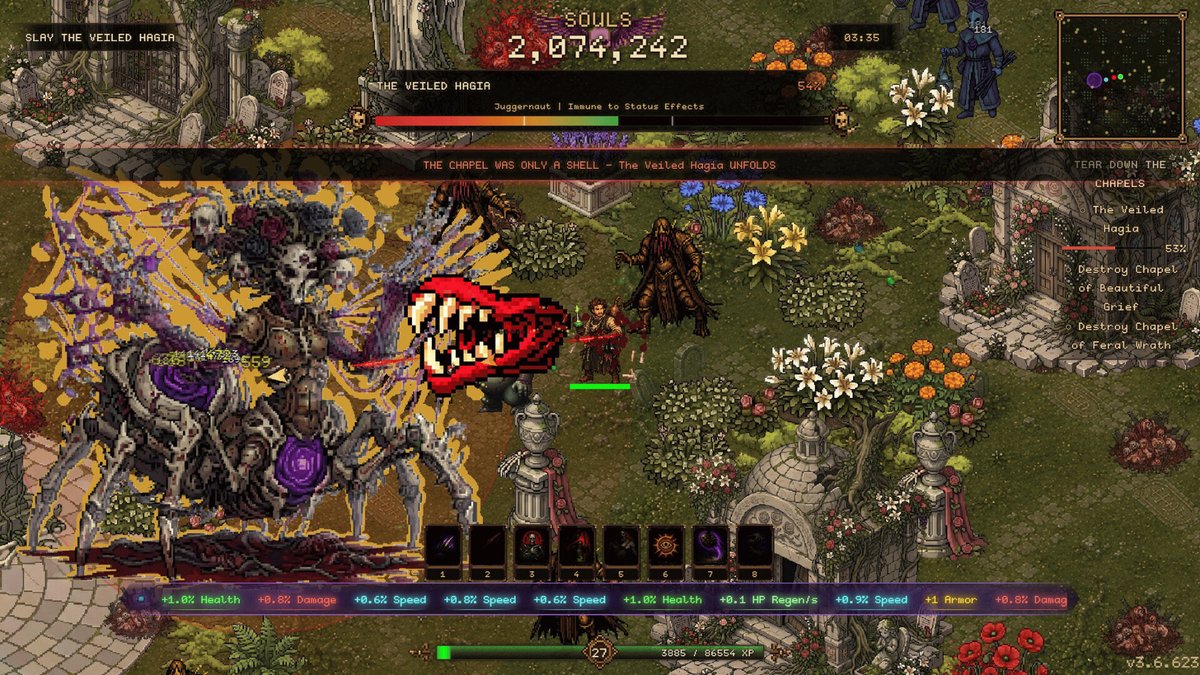
On the games side, a solo developer showed five weeks of After the Wind, built with Claude Code and Codex and "judged in game and iterated". Another built a playable 3D game in two days and itemised the bill. The same day IGN reported Steam players asking for a "no AI" filter as Next Fest filled with generated games, and a Show HN offered an app that flags AI music. The work and the pushback arrived together.
Motion design: make the agent look at its own frames
The motion posts agreed on one habit: don't trust the first render. @0xVorzen asks for a scene map with frame ranges before any code, then renders one still per scene. His caught a waveform running off the panel and labels wrapping. @sonicdr1p's summary of a 20-minute tutorial explains why "one prompt" films are never one prompt: the model scores its own render and redoes anything under 7–8 out of 10, and the widely shared film took 163 model calls and almost 7 hours. His favourite trick is a code-generated 120 bpm track saved to beats.json, with the animation retimed to it.
The most-bookmarked post in this edition lays out a whole studio in one Claude Code folder. HyperFrames turns HTML into video, alongside Remotion, GSAP and LottieFiles motion skills and Blender, with a brand/ folder for colors and fonts and a /schedule routine that drafts three promo clips every Monday and waits for approval. Not every result was flashy. A MiniMax M3.1 Flash explainer came out "presentation type", and a gothic trailer used no AI video model at all: Magnific layers were animated in After Effects by Claude-written scripts.
Image: MOSS-Image moves into real workflows
MOSS-Image support landed in ComfyUI at the start of this window, and the posts quickly turned practical. There's an inpainting workflow that keeps everything outside the mask pixel-exact, and a multi-LoRA workflow that adds a layer-skip node to reduce anatomy errors. A YouTube walkthrough shows that it can spell, and movie-poster layouts come out with readable titles and credits. Training advice was concrete. One trainer says to start a character LoRA at about 800 steps on 8 GB of VRAM, not 8,000. Another changed the noise schedule and reports about 70% ArcFace likeness from epoch 20 to 60. Outside MOSS, a new ComfyUI node turns one reference into a full character sheet, and one creator priced four image models side by side on the same prompt.
3D, sound and the rest
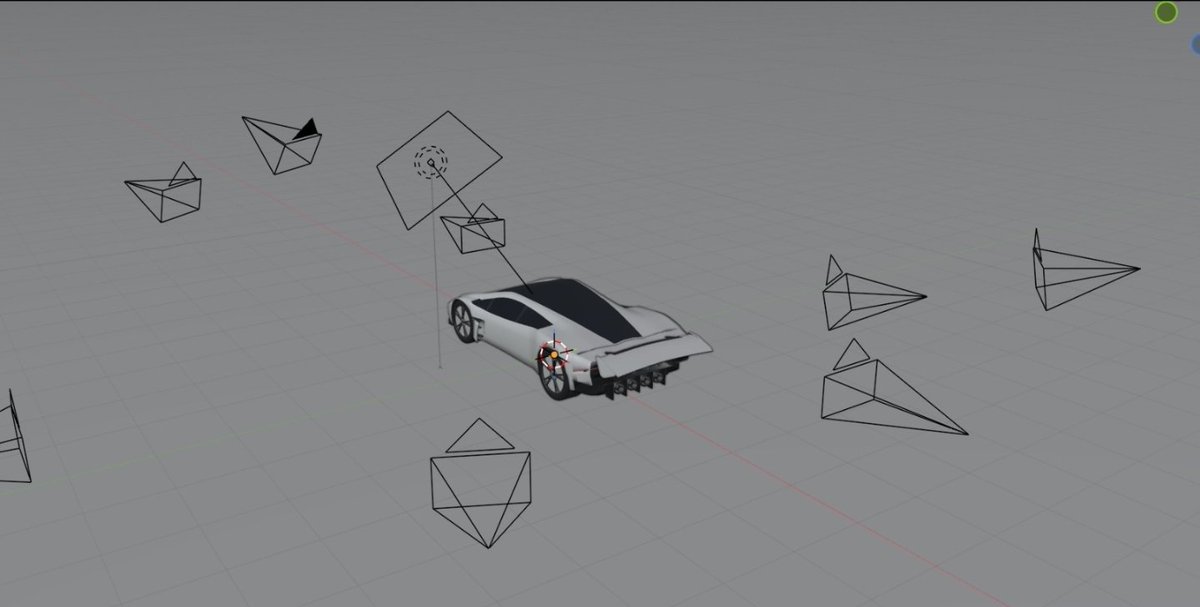
In 3D, Loopcut puts an agent inside a Blender fork that runs on a ChatGPT plan, with no MCP or API key needed. An architect used Paper and Blender MCP for a primary-school massing study with two scenarios side by side. Another creator turned a 2-minute 360° video into a Gaussian splat and shared capture tips: 8K/30fps, slow movement, two passes at different heights. In sound, a free CC0 effects library is built for agents to pick from, Ming-3.0 TTS arrived as ComfyUI nodes, and a small app cleans Suno exports. In the oddest mashup, two language models chose a project together and made a song and video about a fridge and a toaster.
What to watch next
Two things to watch: whether more working professionals publish client workflows like Cardoza's, and whether performance claims for AI ads (cost per lead, downloads, revenue) start arriving with numbers anyone can check. Tell us which topics to chase next: a medium, a tool, or one of these stories.
















 Great Creation Studios