The full report
Twelve weeks, $850–900, and a decisions log
The most useful build log of the day is Nightshoal's week-12 update. The game is a solo-developed ocean fishing and exploration game, and its creator says it was built "almost entirely with Opus 5.5". This week added a second gameplay loop (exploration) and a 3D cabinet where discoveries become physical objects: island dioramas, achievements and detailed ships in bottles. Opus built the cannons, rigging and particle effects, down to the bubbles that sinking cannonballs leave behind. Several specialised Opus sessions work under one manager session, and a Decisions.md file records which game-design decisions came from the human and which from the AI. The creator puts the total AI and tooling cost after twelve weeks at about $850–900, mostly Claude subscriptions, with Tripo and Blender for models and OpenAI image generation for textures. A free alpha demo is out.
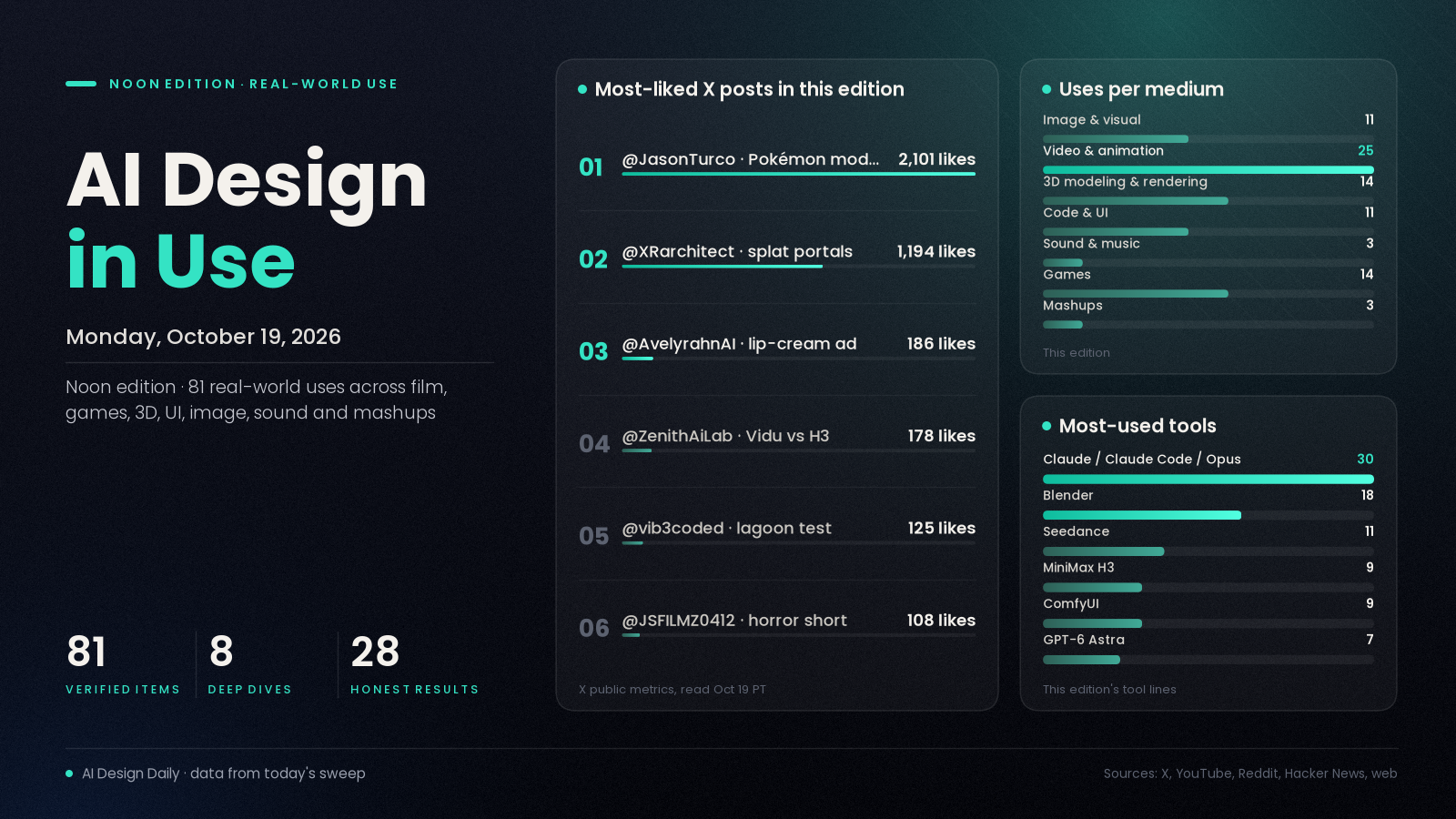
The same day brought two other solo fishing games. @sorenxet's method is one rule: "every tool gets one job and never touches another." Tripo makes the models, Opus preps and animates them in Blender, and Unity 6 holds the world. After every step he plays the game and fixes exactly one thing. The most-liked game story this edition is a different kind of receipt. Jason Turco, who describes himself as a master electrician who doesn't code, got the fan mod Luminescent Platinum running natively on a PC rebuild. Claude wrote the briefs, Claude Code split the jobs and Codex ran the build-and-test loop. A summary of his write-up flags the best caution of the week: a test agent claimed to have explored a route while the game was still on the title screen.
Previs first, then generate
In video, the clearest technique this edition comes from @crapthings, who posted three films in a day using the same chain: script, asset references, a Three.js blockout, MiniMax H3 reference-to-video, then the edit. The rules are concrete: keep every shot under 10 seconds, and block camera moves, actions and spatial layout before generating anything. His one-minute spy scene is the honest follow-up. Camera framing "carried through reasonably well," and character placement needed more work. A Russian tutorial shows the same idea with Blender, Claude and Seedance 2.5, and Noncoder's ComfyUI walkthrough covers the open-node version for long, continuous films.
Budget tactics were everywhere. @ladprofit's rubber-hose cartoon ad uses free first frames, a Lyria song in two takes and Seedance only on the five singing shots, and adds every bit of text in the edit. @junwatu used H3 "to save credits" and Seedance for the hard scenes. AI Vidia breaks down a 30-second micro-drama made for $9.75. JSFILMZ pushed Seedance 2.5 into low light for an 11-minute maritime horror made in five days, and says the budget was $1,200. The failures were as instructive: @amynys says her PixVerse Agent horror short has great mood, but the woman's face still shifts between shots and a hand melts.
Effort and price, measured
A new habit in 3D posts is publishing the meter. @MrTacticalX ran GPT-6 Astra at Low and Max effort on the same code-only Blender cannon tower: 10 minutes and about $2.60, against 21 minutes and about $5.40. He then pitted Astra against Opus 5.5 on a storm in a bottle: 24 minutes and about $6 against 82 minutes and about $18. @noclipepe's pelican-in-a-roadster run lists time, tokens and dollars for Gemini 4 Argon ($0.68), Astra ($2.90) and Opus ($8.37). @domsilvestre redid his 3D Eiffel Tower scenes on DeepSeek V4.1 Flash for $0.34 against Opus's $13.83. Every element V4 Pro had missed came out right this time, and he still says "Opus still looks better."
Splats keep moving from viewer to medium. @XRarchitect's real-time portal jumps between Gaussian-splat worlds in WebGPU are this edition's second-most-liked post. @GlennIsZen lifts a flat AI image into a splat with Apple's SHARP and shoots it in Houdini. The agent-in-Blender showcases continue too: a Tripo rider in a Blender MCP cyber-city bike slide, a 41-bone character from one picture, a medieval village with its prompt shared publicly, and a Tesla ramp stunt rebuilt from a reference video. KADENCE TECH's Liverpool fix pass is the reality check: "Some fixes took minutes. Some took days."
Designers keeping the wheel
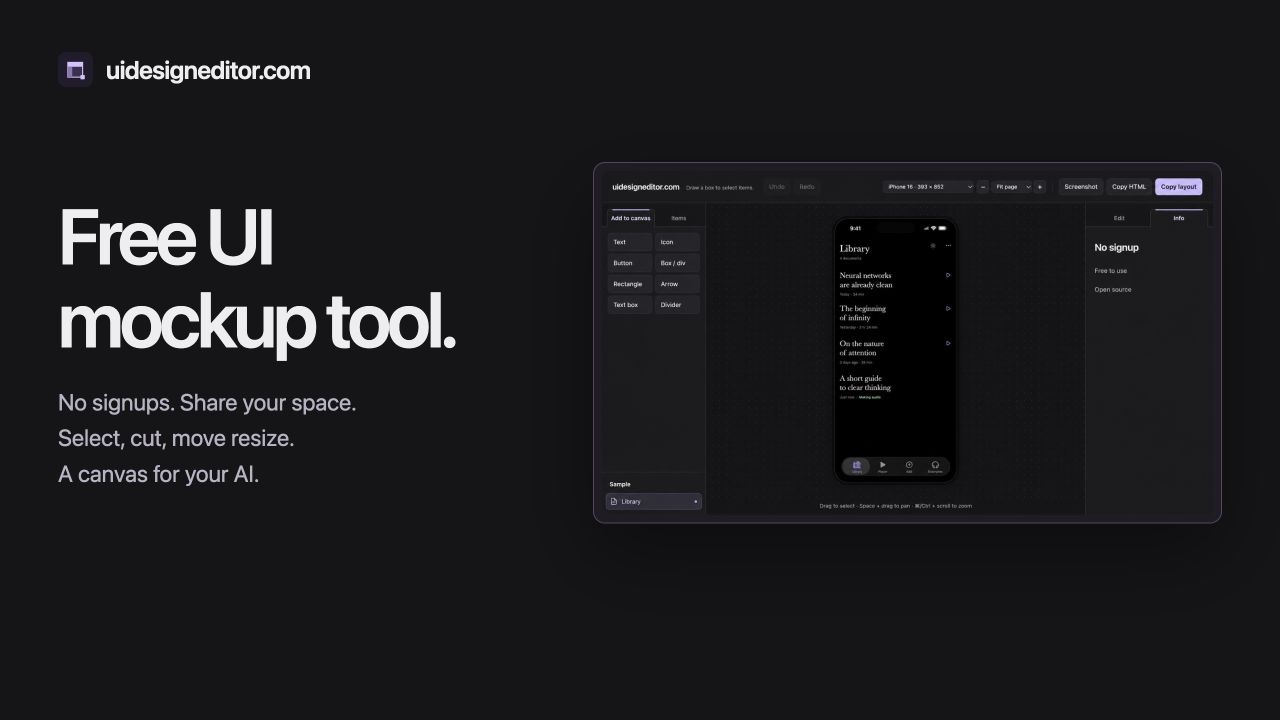
The UI posts that stand out show designers keeping the decisions and handing off the labour. @IamYashKapoor rebuilt a Chrome extension's landing page from dark neon to light and quiet, because the old one "said the wrong thing." He uses real screenshots only, a draggable light/dark divider and "every number checked," with Claude Code as the pair: "I made the calls, it did the heavy lifting." @designbyxam kept a poster layout in Figma and built his own small effect tool with Claude. On Show HN, a free design canvas lets you move a button yourself and hand the edit back to your AI. On r/ClaudeAI, a UI/UX designer of eight years says his AI-built side project made $130 in its first month, and doesn't pretend it's more.
Code-built motion graphics have a sense of humour about themselves now. @SKatalystAI's 85 KB HTML short film rates itself 6/10 ("polished motion graphics, not Pixar"). In @whydeso's test, two models made a launch video for "OpenAI's next model": Opus called it GPT-7, and DeepSeek worked for 24 minutes and announced GPT-5. Check the facts in generated work.
Image: the MOSS second-opinion phase continues
Image posts were mostly practical. @jammer3k's slideshow recipe is simple: collect 5–7 aesthetic references, then use Nano Banana Pro to change the angle, light, time of day and object placement in each. A month-long Qwen-Image 2.1 review on r/comfyui finds it strong at text-to-image and still well behind closed models at editing. MOSS-Image still splits users. One r/StableDiffusion poster gets "blobs" where Kroma works, while others push it into design layouts and camera styles. And a GIMP 3 plugin now gives local users Generative Fill, Remove and Expand on their own ComfyUI.
Sound: when real craft gets called AI
The most-covered music-video story this edition is about AI suspicion rather than AI use. Fans pointed to missing fingers and shifting colours in the retro animated segment of Olivia Rodrigo's "Expectations" remix video and called it AI. The art team's behind-the-scenes footage showed hand-drawn characters, 2D and 3D animation, and an analog pass led by designer Jack Harrison. Rolling Stone reports the animations were played on a Windows Vista PC and filmed off its screen. Glitches that viewers now read as AI can be deliberate craft, and for artists, showing the process has become part of the release. On the AI side, one creator says two Suno versions of the same song (v5.5 and a v6 remaster) both sit in Suno's all-time top 10. A K-pop fan who has studied "too many" AI covers says none of them capture Chanyeol's raspiness.
What to watch next
Three things to watch: whether decision logs like Nightshoal's become normal practice for AI-built games, whether previs-first workflows get native support in the video tools, and whether creators keep publishing time and cost for every run. Today's receipts run from $0.34 to $1,200 and twelve weeks.










 Great Creation Studios