AI Design in Use · Noon · Friday, October 23, 2026 · catch-up edition
Grey mannequins for AI actors, a one-person voxel studio, and the work of keeping one look
The most reusable tip in this window came from a post almost nobody saw. A team kept AI video actors on their marks by showing a grey-mannequin blocking pass for only the first few steps of generation. Around it, creators laid out full pipelines: a voxel short built through Blender and Remotion, and a motion-graphics setup that stops Claude Code drifting. Spec ads went out for brands that never asked, and Kling 4.0 against Seedance 2.5 tests disagreed with each other. Gaussian splats kept moving from demos into real jobs, from a collapsed-wall survey to an event pitch.
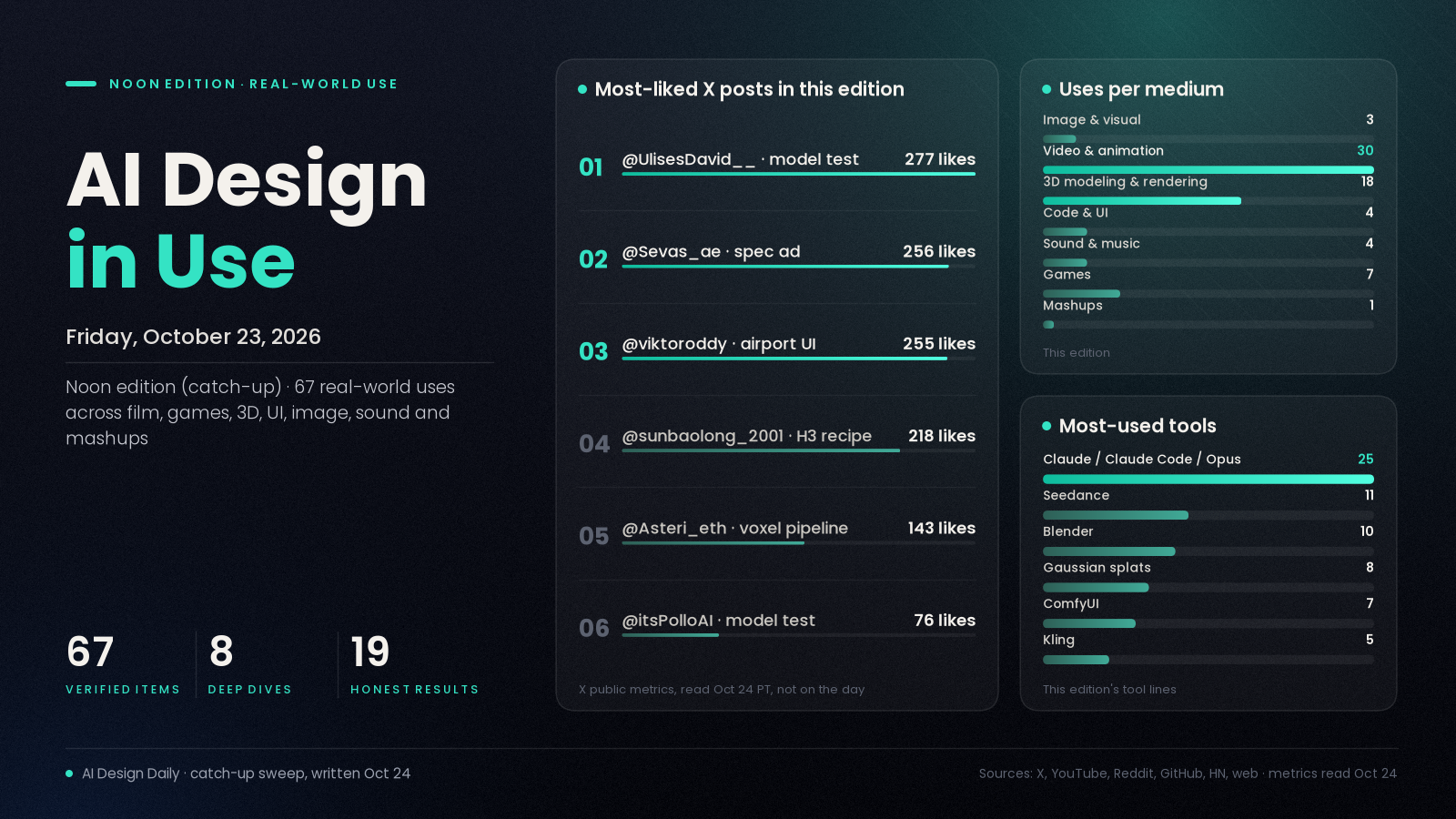
This is a catch-up edition, written on Oct 24 for Friday, Oct 23. Items were posted between noon Oct 22 and noon Oct 23 PT. Engagement figures (likes, views, bookmarks) were read on Oct 24, not on Oct 23, so they include an extra day of traffic.
67 verified items · 7 mediums · 19 honest results · sweep window noon Oct 22 to noon Oct 23 PT
The full report
Direct the model instead of re-rolling it
The best idea of the day is two sentences long. A small team posting as adreaman says its AI video actors kept missing their marks. A 3D animation of grey mannequins fixed the positions but made the acting stiff. Their answer was to show the mannequins for only the first 5 of the model's 20 steps, then limbless poles for 2 or 3, and then let go. The post had no likes when we read it, and it is still the most transferable thing here.
The same instinct shows up elsewhere. TopView's Film Studio, demonstrated in two affiliate videos, lets you place characters and a camera in a 3D scene before generating. One creator built a Seedance short directly from ByteDance's own prompt guide. A breakdown of a two-minute geisha-versus-lion fight says the trick is locking both characters in a few Midjourney stills, then animating shot by shot so the faces never drift. Each one decides the shot first and generates second.
Pipelines, not prompts
Two of the three most-bookmarked posts were recipes. Asteri_eth's six-step voxel pipeline runs from a written joke to a Blender scene built through an MCP and on to a Remotion cut. It has concrete settings: 1 voxel = 2 mm for believable depth of field, and a contact sheet of every 12th frame before the full 360-frame render. Paul Borg's video tackles the commonest complaint about agent-made motion graphics, that 'ask twice and you get two different looks'. His fix is a curated UI library, written rules, an audio check and a human review pass. Ryan Musselman has Claude measure another YouTuber's editing style frame by frame and turn it into a rule-based template.
Small businesses are using the same tools without the craft talk. A tax practitioner shared the Claude Design prompt he used to make a promo video for his firm from his website and logo, which he says takes under 10 minutes. On Reddit, one user let an agent work overnight on a 7-minute 'I investigated' documentary. He used LTX-2.5 for video at about 2.5 minutes per clip, and the interview lip sync came out of the same pass.
Spec ads and fan films
Unsolicited ads were everywhere. Sevas_ae's spot for the trading app fomo, made with After Effects, Blender and Opus 5.5, was one of the most-saved posts in the edition. A knitted-city sneaker ad and a Red Bull racing spot came with their recipes, and the Red Bull spot's driver was made from text with no character reference. A fan made the music video he wished existed for Ruger's 'Toro'.
One result left the feed for the real world. Jae Solina's Seedance 2.0 short The Detective is a finalist at the AI Movie Awards in London, and Roast Brief's finalist list confirms it. He says he pushed for one-minute continuous takes when most clips were 15 seconds.
Kling 4.0 against Seedance 2.5: it depends on the scene
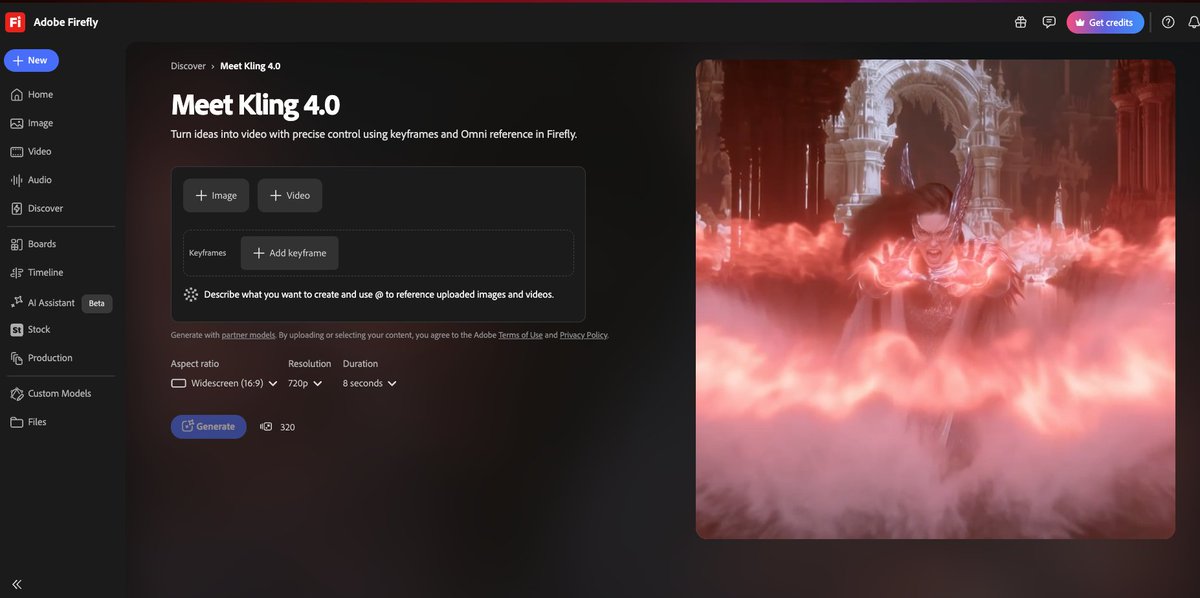
Several creators ran their own comparisons, and they didn't agree. On a crowded market chase, UlisesDavid__ found Kling 4.0 close to Seedance 2.0 but still behind Seedance 2.5. A Chinese creator gave Wan 3.0, Seedance 2.5 and Kling 4.0 the same prompt once each. He rated Kling best and cheapest, with Seedance the most expensive. Huss Ali made one lighthouse-keeper short in both and judged them on what a finished film needs: a consistent face, a storm, wordless acting and cost per shot. Pollo AI's stylized 3D comparison comes from a company that sells both. The useful lesson is to test on your own kind of scene.
Splats get real jobs
Gaussian splats showed up as working tools, not just eye candy. Split View Studio scanned a wall that collapsed onto parked cars, scanned it again after cleanup, and aligned the two into a navigable before-and-after tour. Joshua de Bruin isolated a stone F1 car from a splat, dropped it into a SketchUp garage and rendered an event concept by day and night. A homemade depth-camera rig went from bent walls to a metric room splat, though it is still offline and misses dark walls. On the tooling side there were real lens optics in Blender's viewport, texture-driven splat reveals in TouchDesigner, and a 1970s virtual camera. The MIT-licensed image-blaster skill set turns one photo into a splat scene with models and sound.
3D, print and games
The clearest case study is an iPhone modelled in Blender with Opus 5.5 and then shipped as a .glb to a landing page for a Berlin retailer, where scrolling changes the finish. The author is frank that the camera block's materials 'came out bad' and needed more references. Print shops showed a full loop, from a pen holder modelled by an agent to slicer tests, renders and a Cults3D listing. A free text-to-CAD tool was put through three engineering tests.
In games, a Roblox developer reports what five months and four AI-built games actually earned against ad spend. Second Shift, a mech-repair simulator, runs inside the Rive editor. A 3D side-scroller was built in one Claude Code chat over two days, using three.js and no Blender.
Where it still breaks
The honest posts are worth as much as the polished ones. One ComfyUI user tried a dozen workflows to extend a MiniMax H3 clip without a cut, and none worked. Another hunting for two-view mocap sync found Wan 'very bad' and LTX 2.5 good on motion but out of sync. A Suno user excluded a long list of styles and still got 'over-polished generic' output, the day after his subscription renewed. Another rebuilt a hosted video app on his own GPU after losing credits to false content flags on safe prompts. None of these are failures of ambition. They mark where the tools need a human, a workaround or a better model.







 Great Creation Studios